News
Grabbity LMS: lending platform for the Baltics and Nordics
Partner content. Grabbity LMS runs the whole loan journey in one system: nine products, loans against crypto with LTV monitoring, e-signing and double-entry accounting. Available to try in an open demo.

Partner content. Latvian company Grabbity has built a loan management system (LMS) for non-bank lenders in the Baltics and the Nordics: from product setup and application scoring to signing, servicing, collections and double-entry postings. We look at nine products, loans against crypto and shares with LTV monitoring, the CCD2 context and the open demo.
Grabbity LMS: a lending platform for Baltic and Nordic lenders
Partner content. NorriWire and Grabbity are related: both were founded by Toms Ābeltiņš. This article describes a Grabbity product, so please read it with that in mind.
Non-bank lenders in the Baltics and the Nordics run more and more products: credit lines, leasing, loans against crypto and securities, business finance. Often each product has its own system, its own spreadsheets and its own export for the accountant. Latvian company Grabbity has built a loan management system (LMS) that runs the whole loan journey in one place, and it can now be tried in an open demo.
Why this matters now
From 20 November 2026, EU member states apply the new Consumer Credit Directive (EU) 2023/2225, known as CCD2. It extends the rules to small loans and "buy now, pay later" products, requires a more thorough creditworthiness assessment and clearer pre-contractual information. For a lender this means one thing: every figure the customer sees must be traceable to the system it comes from.
The second trend is lending against crypto. The MiCA regulation does not directly regulate crypto-asset lending, so it is offered by lenders that already run secured loans. What matters most here is monitoring collateral value at market prices, not at the valuation made on the day the loan was issued.
The loan journey in one system
Grabbity LMS covers eight stages from product setup to the ledger entry. A product (amount and term limits, rate, fees, collateral type) is defined in settings, not in a new software release. An application arrives from the website or the operator screen and is scored automatically, but disbursement does not proceed until an employee approves it. Actions that move money are confirmed by a second employee - the four-eyes principle.
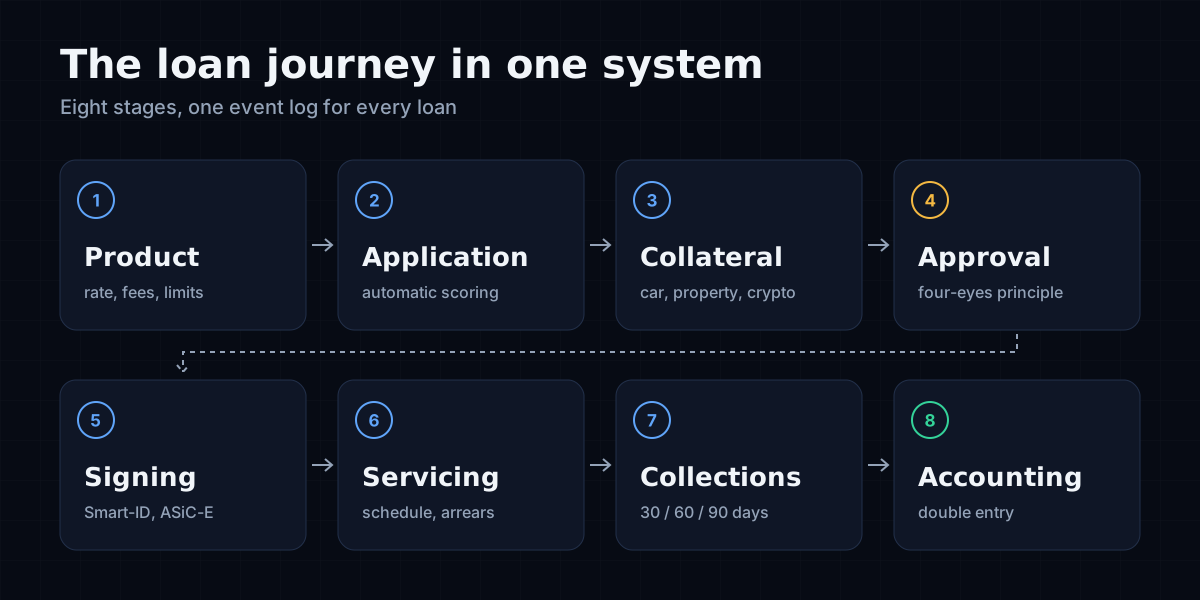
The customer signs with a qualified e-signature (Smart-ID, Mobile-ID or bank identification), and the platform stores the signed document in an ASiC-E container with a timestamp. The customer sees the standard information and the payment schedule before signing, and all figures are fixed in the document at disbursement: what the customer saw is what the customer signed.
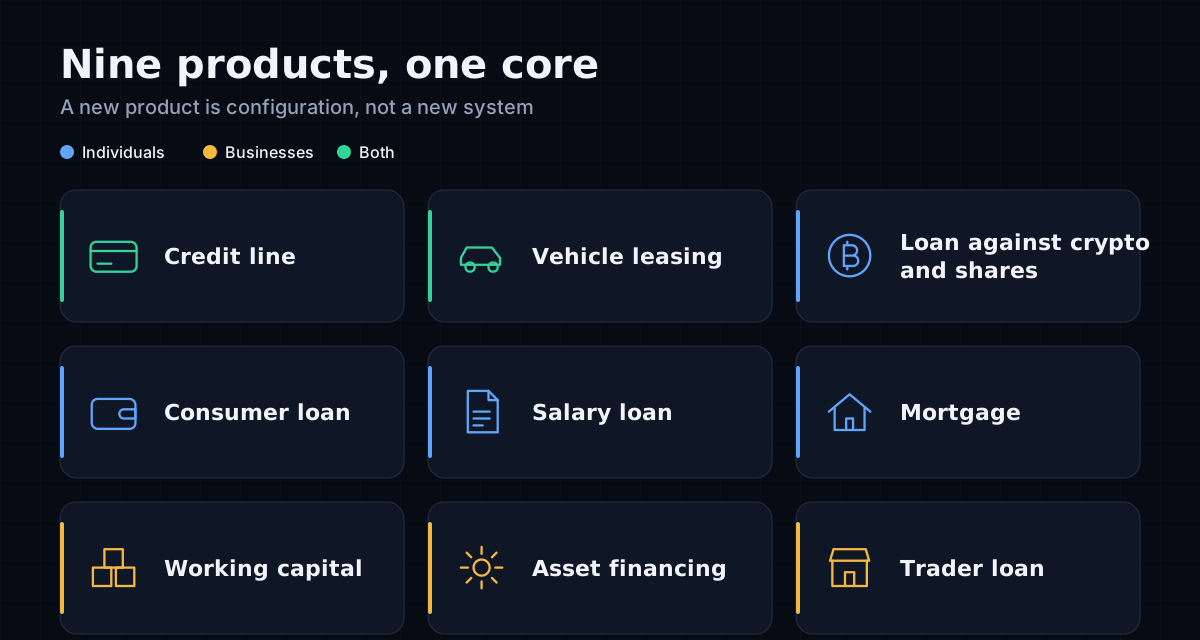
Nine products, one platform
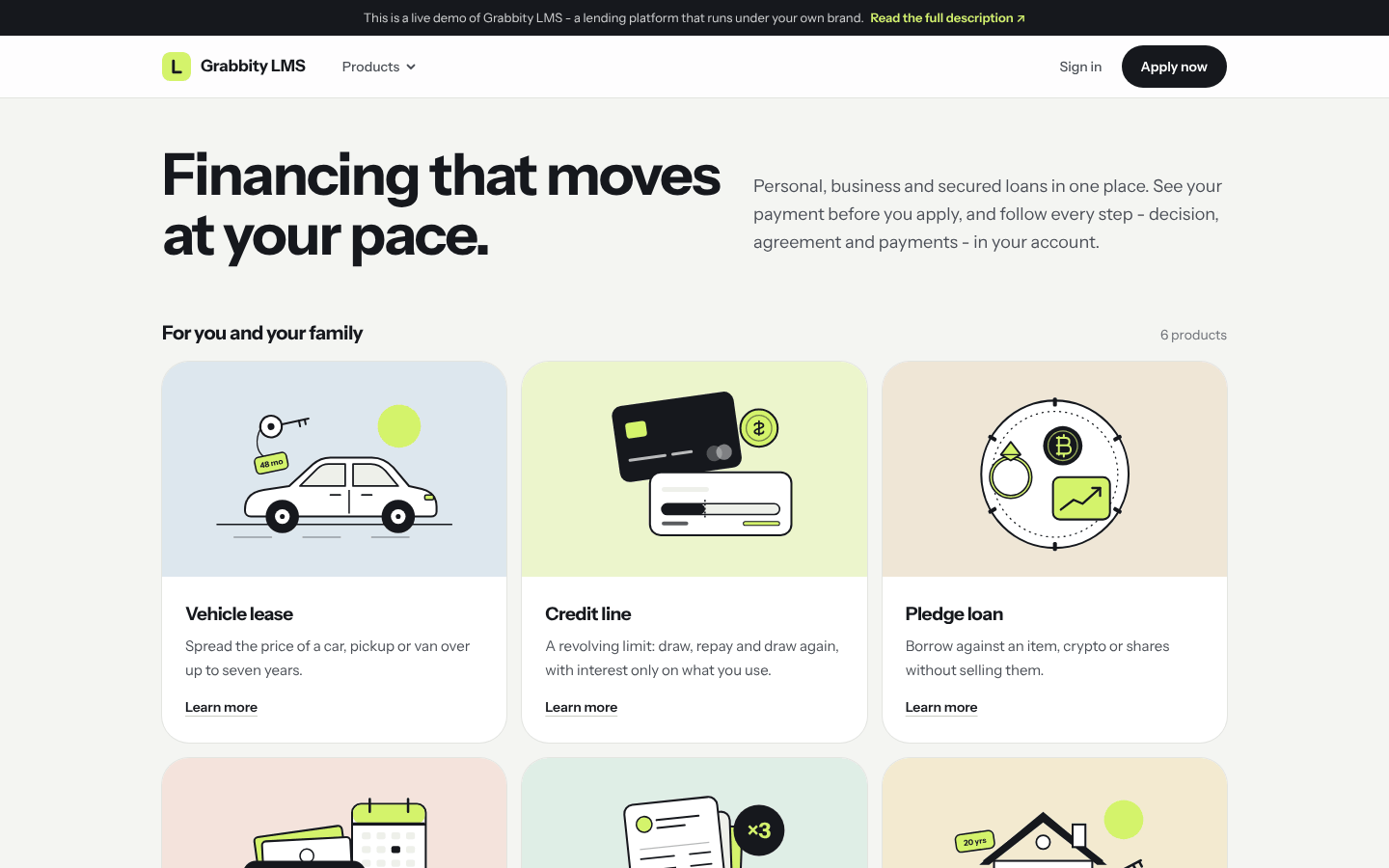
The demo has nine loan products for individuals and businesses. They all run on one core: the same scoring, the same documents, the same general ledger. A new product is configuration, and the platform runs under the lender's own brand.
Loans against crypto and securities
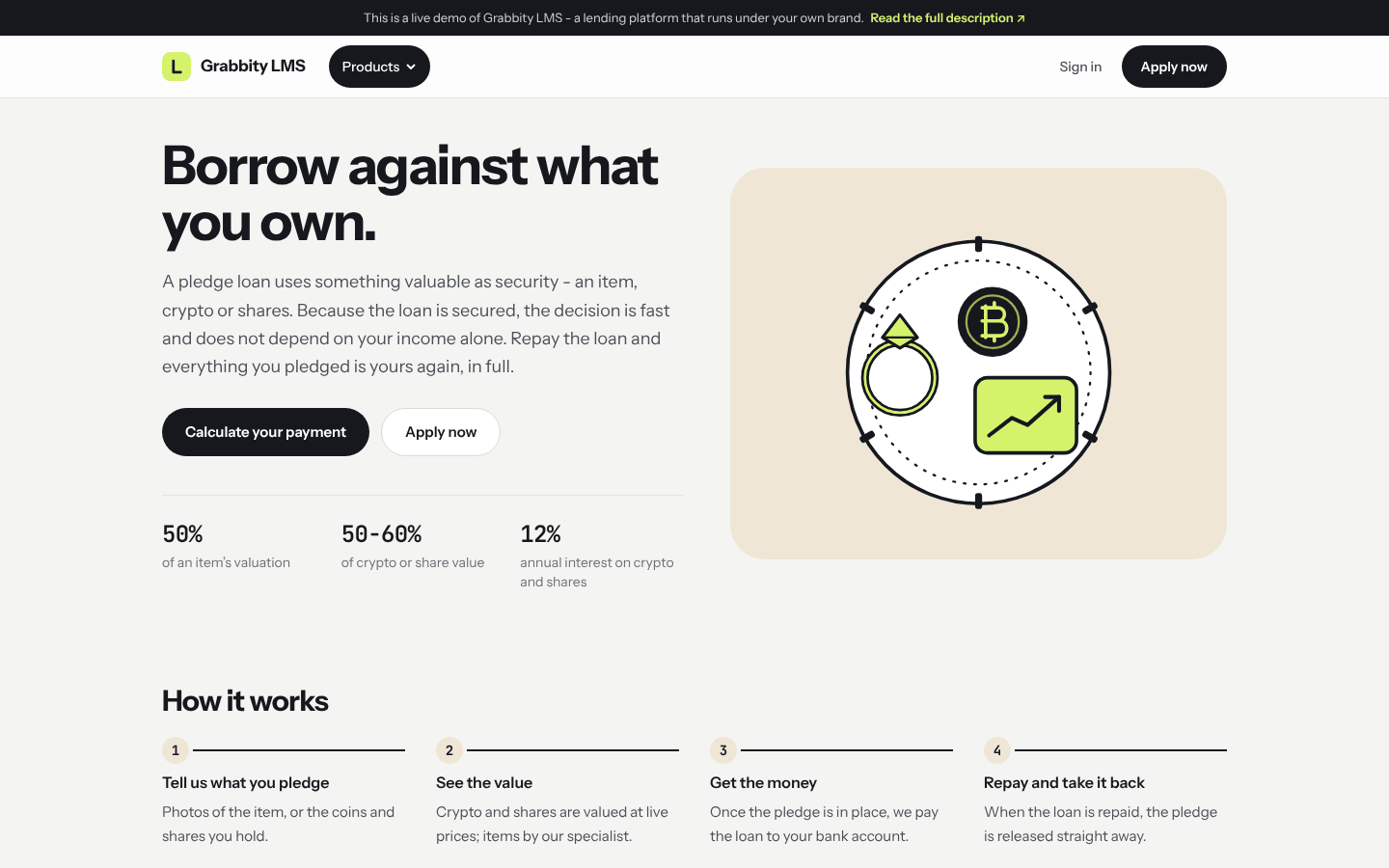
For crypto readers the pledge loan is the most interesting part. The customer pledges crypto, shares or a valuable item instead of selling it. The platform stores the quantity pledged, not a fixed amount, so the collateral value follows the market price. The loan-to-value ratio (LTV) is monitored against two thresholds: at the first the customer is asked for additional collateral, at the second liquidation begins. The lender sets the thresholds in the product settings.
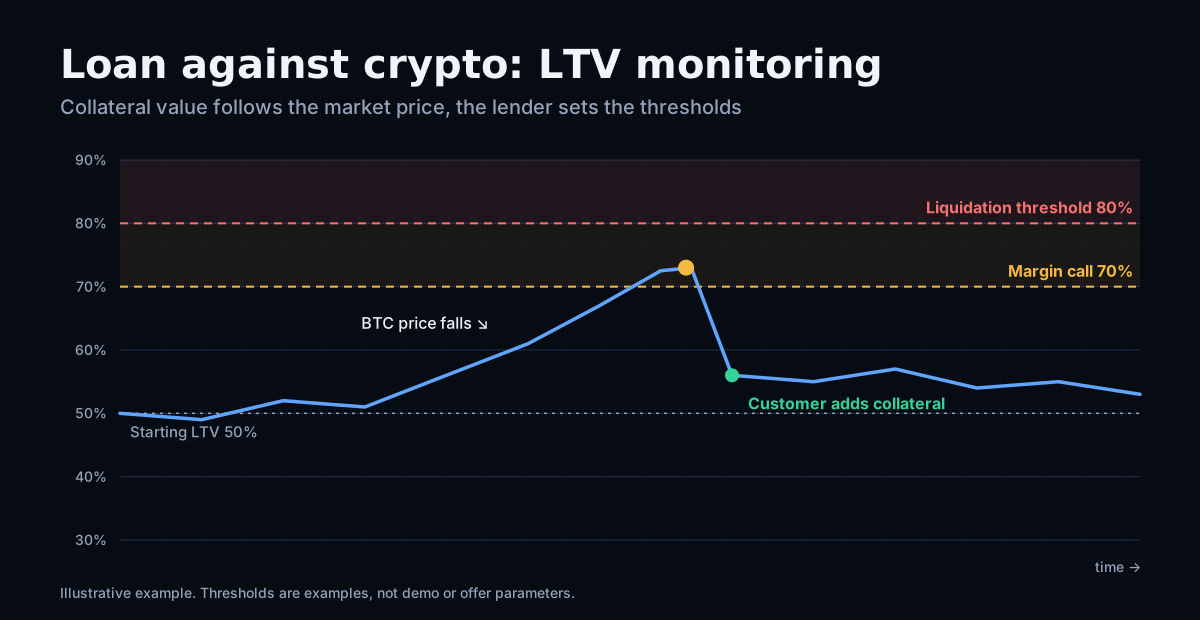
In the demo product, a loan against crypto or shares is up to 50-60% of the collateral value at 12% annual interest. These are demo parameters, not an offer.
Servicing, collections and accounting
The platform reads incoming payments from bank statements (camt.053) or through the bank's API and matches them to a loan by contract number, IBAN or personal code. A reversed payment does not erase history: a reversal creates an opposite transaction and a new schedule version. The portfolio report shows arrears in 30, 60 and 90 day buckets, and collections have their own work queue with escalation stages.
Accounting is not an export file. Every event creates a double-entry posting, from which accruals, period close, the trial balance and the balance sheet follow.
What already runs on it
E-Kredīts in Latvia runs on this platform. Grabbity states that the systems it has built serve more than 15,000 customers a month, with 99.95% platform availability.
Try it yourself
- Demo: lms.grabbity.eu - apply as a customer, then review the same application on the operator side.
- Full description: grabbity.eu/en/lending-platform
Sources
- Grabbity lending platform (LMS)
- Grabbity LMS demo
- Directive (EU) 2023/2225 on credit agreements for consumers (EUR-Lex)
- Regulation (EU) 2023/1114 on markets in crypto-assets (MiCA, EUR-Lex)
This article was prepared with AI assistance and reviewed by the editors. It is partner content, not financial advice.